


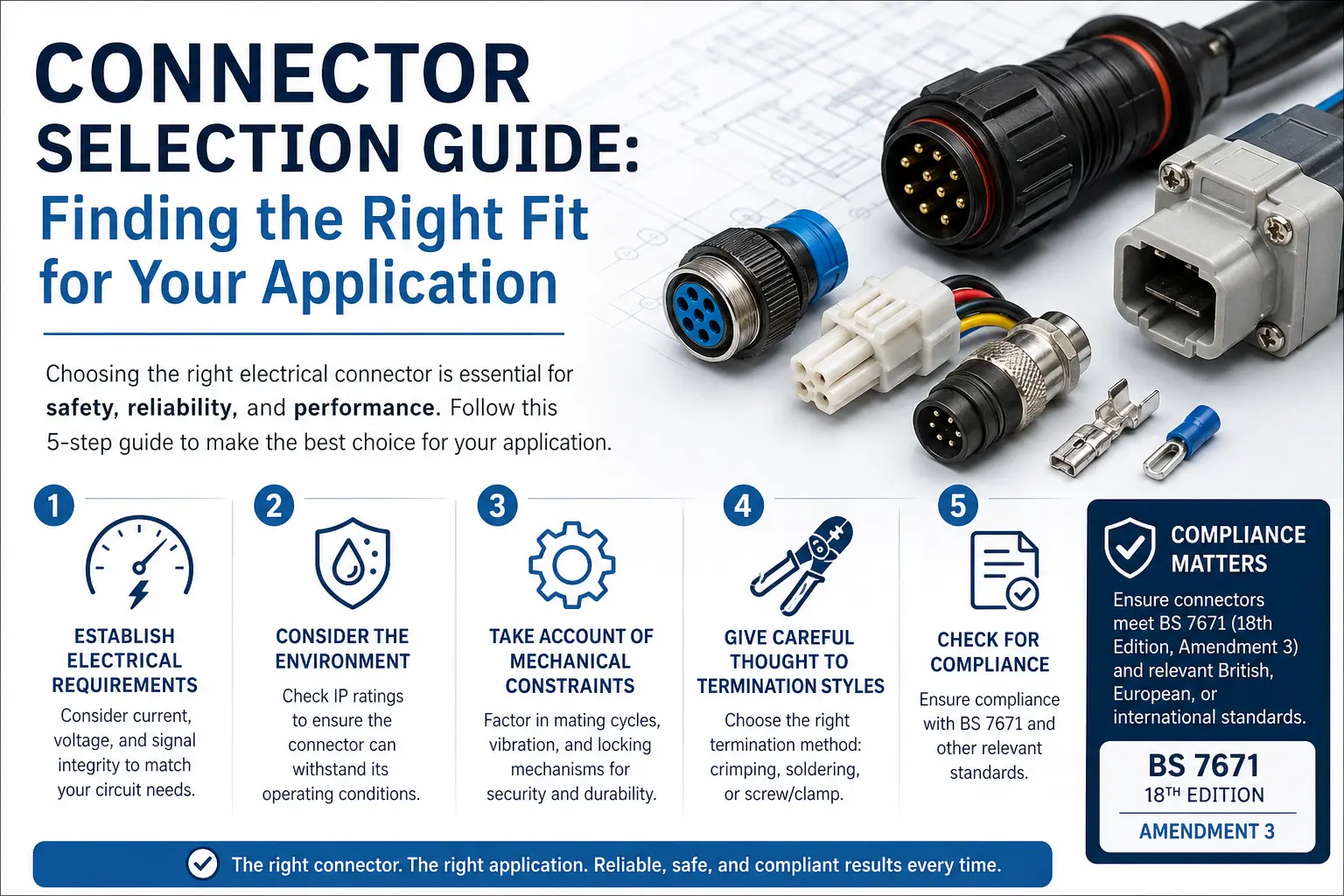
The critical role that electrical connectors play across all manner of systems and equipment is beyond doubt. Much the same can be said about the importance of selecting the right connector for a given application.
Connectors appear seemingly everywhere from domestic socket wiring and appliance leads to electric vehicle (EV) chargers and heavy machinery. So, the decisions that you make around the electrical connectors for your own projects will clearly be crucial ones.
We have written this guide chiefly with UK audiences in mind. However, much of it is broadly applicable wherever in the world you may be working on electrical circuits.
The Importance of Choosing the Right Electrical Connector, Every Time
When the most suitable electrical connector is chosen for a particular context, this goes a long way to ensuring the optimal safety, reliability, and performance of the given electrical systems.
Making the wrong decisions on connectors, though, can drive up risks such as overheating, water ingress, mechanical failure, and non-compliance. Even “just” the latter problem, for instance, can potentially lead to failed Part P inspections or insurance issues.
5 Steps to Deciding on the Most Suitable Electrical Connector
Picking the right electrical connector isn’t merely important; it is also a more complicated process than just matching pins to sockets.
So, whether you’re a professional electrician working to BS 7671 (the IET Wiring Regulations), a DIY enthusiast taking on a home project, or an engineer specifying parts for industrial or automotive use, here is a guide to help you decide on the right connector for your project.
- Establish What the Electrical Requirements Are
Inevitably, any consideration of the appropriate electrical connector for a particular system will require you to start with the basics. Whatever connector you choose will need to be able to handle the power and signal demands of your circuit, without overheating or signal loss.
This will require you to pay close attention to such aspects as:
- Current rating (amps). The connector you pick must be able to handle the maximum current. Don’t forget to “derate” for high temperatures.
- Voltage rating (volts). Checking that the insulation can withstand the operating voltage will also be crucial, to guard against the risk of arcing.
- Signal integrity. For data or high-frequency signals, you should look for shielded connectors to prevent electromagnetic interference (EMI).
- Consider The Environment in Which the Connector Will Be Operating
The combination of notorious British weather and the harshness of industrial settings, means electrical connectors in this part of the world often need to stand up to significant punishment.
Ingress Protection (IP) ratings are a critical element here. Each IP rating takes the form of a two-digit code. The first digit refers to the level of protection against solid objects and dust, while the second digit denotes protection against water.
To give a few examples of such ratings: in dry indoor locations, a rating of IP20 or IP40 will often be sufficient. By contrast, in submersible or harsh industrial settings, higher ratings such as IP67 and IP68 are essential for electrical connectors.
- Take Account of Mechanical Constraints
This stage of the decision-making process entails consideration of how and where the connector will be used.
The anticipated mating cycles will be a crucial factor. If, for instance, you expect the connector to be plugged and unplugged daily (like a charger), high durability will be necessary. Alternatively, it might be that the connector will be used for “fit and forget” internal wiring, in which case, an option designed for lower mating cycles will be fine.
Don’t overlook the locking mechanism, either. In a high-vibration environment such as an automotive or rail setting, using connectors with bayonet, screw-head, or push-pull locking will prevent accidental disconnection.
- Give Careful Thought to Termination Styles
By “termination styles”, of course, we’re referring to the methods used to securely join wires to electrical connectors for electrical continuity.
Some of the key termination styles you might look at include:
- Crimping, whereby a metal terminal is mechanically compressed around a stripped wire. It is a fast and reliable method for high-volume production, but it does require specific tooling.
- Soldering, which involves conductive materials being fused with molten solder. The result is a very dependable and tough electrical bond that works well for prototyping and permanent, low-resistance connections.
- Screw or clamp termination, whereby the wire is secured within the terminal by tightening a screw or clamping mechanism. This method can be ideal for field wiring and applications necessitating easy installation, modification, or removal.
- Check For Compliance with Relevant Standards
It is essential for electrical connectors and accessories used in the UK to meet British Standards (BS) or relevant harmonised European or international standards, to ensure safety and compliance with regulations. So, this is something else you must verify.
The aforementioned BS 7671 is the national standard for electrical installations in the UK. All fixed wiring and connected accessories should comply with the latest edition. At the time of typing, this is the 18th Edition, Amendment 3, although Amendment 4 was published in April 2026 and will eventually replace previous amendments.
Go Through These Stages to Ensure the Best Connector for The Job
Remember: there is no “one-size-fits-all” electrical connector. The good news, however, is that by following the structured approach we have laid out above, you can ensure you choose a connector that strikes the right balance of performance, safety, and practicality.
Accomplishing this will, in turn, greatly support your efforts to achieve reliable and code-compliant results across all your electrical projects.
