


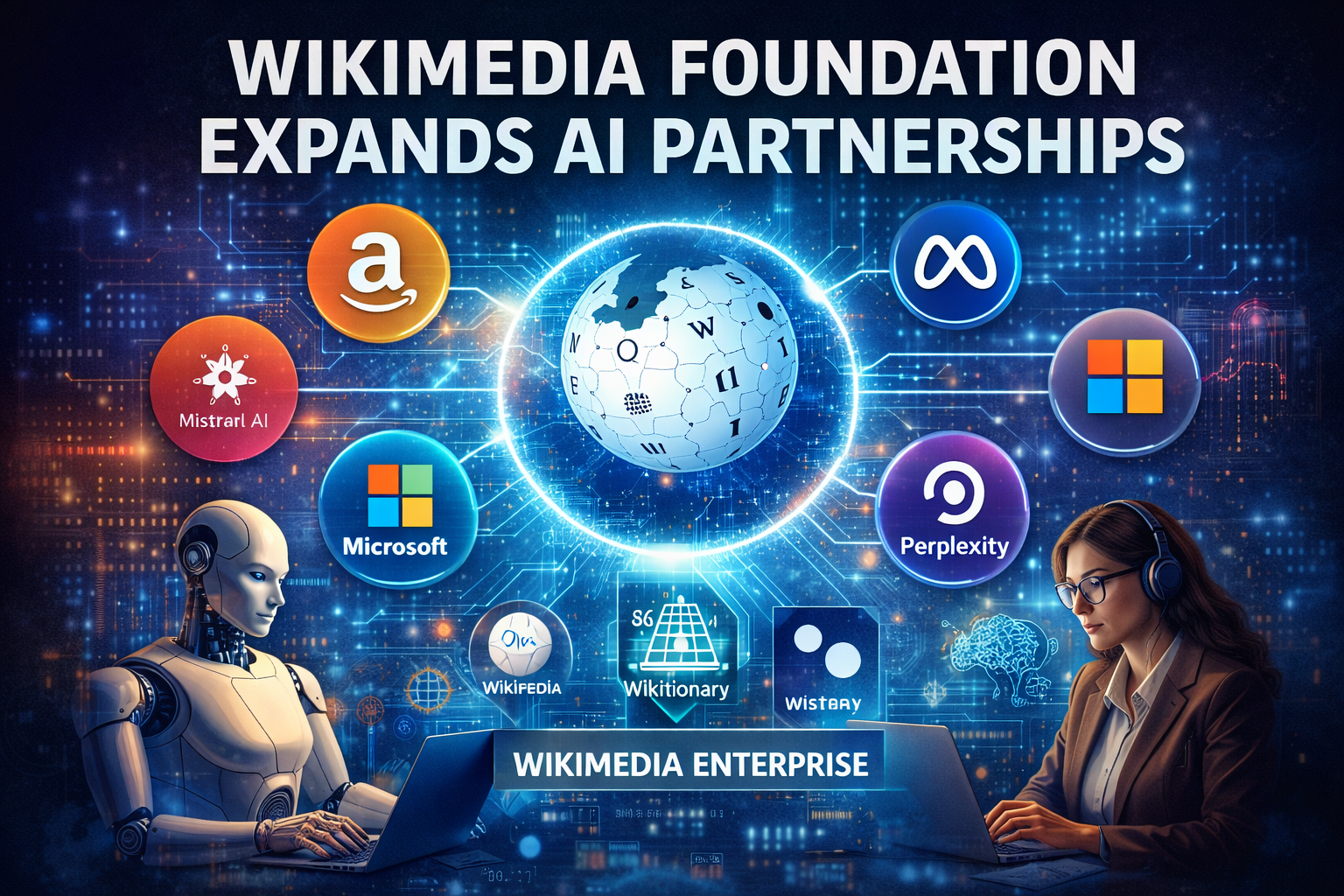
The Wikimedia Foundation has taken a major step toward securing the future of open knowledge by expanding its partnerships with leading artificial intelligence companies. As Wikipedia celebrates its 25th anniversary, the nonprofit organization is adapting to a rapidly changing digital landscape where AI systems increasingly rely on freely available human-created knowledge.
The foundation announced that several global technology companies including Amazon, Meta, Microsoft, Perplexity, and Mistral AI are now official partners through its commercial data service, Wikimedia Enterprise. These collaborations reflect Wikipedia’s evolving role in the age of AI, where its content fuels everything from search engines to generative AI assistants.
Why Wikimedia Is Partnering With AI Companies
For years, Wikipedia content has been used across the internet without direct compensation, especially by large technology platforms and AI models. As AI tools grow more powerful, they increasingly depend on Wikipedia to provide accurate, structured, and trustworthy information.
The Wikimedia Foundation created Wikimedia Enterprise to address this challenge. The service offers companies high-volume, reliable, and frequently updated access to Wikimedia content, while also ensuring that Wikipedia can sustain its infrastructure and community.
Unlike simple data scraping, Wikimedia Enterprise provides:
- Faster content delivery
- Structured datasets designed for large-scale use
- Improved reliability and update frequency
This approach allows AI companies to responsibly reuse Wikipedia data while contributing financially to its long-term sustainability.
A Growing List of Strategic Partners
The foundation confirmed that it has quietly built partnerships over the past year with several major AI and technology players. While Google was publicly announced as a partner back in 2022, the newly revealed list highlights how widespread Wikipedia’s role has become in AI development.
In addition to Amazon, Meta, Microsoft, Perplexity, and Mistral AI, Wikimedia also acknowledged collaborations with:
- Ecosia
- Pleias
- ProRata
- Nomic
- Reef Media
These companies use Wikimedia content to support search, research, language models, and knowledge-based products.
Wikipedia’s Scale Makes It Essential for AI

Wikipedia remains one of the most influential platforms on the internet. According to the foundation, it is consistently ranked among the top ten most-visited websites worldwide.
Key statistics highlight its reach:
- More than 65 million articles
- Content available in 300+ languages
- Around 15 billion page views per month
This massive, multilingual dataset makes Wikipedia one of the most valuable sources of human-verified knowledge something AI models struggle to replicate on their own.
Human Knowledge in the Age of Artificial Intelligence
Despite rapid AI progress, the Wikimedia Foundation emphasized that human contribution remains at the heart of Wikipedia. Articles are written, reviewed, and maintained by millions of volunteers across the globe.
Selena Deckelmann, the foundation’s Chief Product and Technology Officer, highlighted this balance between technology and people, stating that Wikipedia proves knowledge is deeply human especially at a time when AI systems are expanding rapidly.
The message is clear: AI can assist, summarize, and scale information, but human editors ensure accuracy, neutrality, and context.
More Than Just AI Deals: Celebrating 25 Years of Wikipedia
Alongside the partnership announcement, Wikimedia launched a global birthday campaign to mark 25 years of Wikipedia. The celebration focuses not only on technology, but also on the people behind the platform.
New initiatives include:
- A video docuseries showcasing Wikipedia volunteers worldwide
- A “25 Years of Wikipedia” digital time capsule, exploring the platform’s past and future
- A livestreamed birthday event, featuring guests, interactive activities, and special appearances
The campaign reinforces Wikipedia’s identity as a community-driven project rather than a traditional tech company.
Wikimedia’s Own Approach to AI
Interestingly, the foundation is not only supplying data to AI companies it is also experimenting with AI internally. Recent updates reveal investments in:
- Infrastructure upgrades
- Responsible AI tools for editors
- Experiments with games and short-form educational content
However, Wikimedia has consistently stated that AI will be used to support editors, not replace them. The focus remains on transparency, ethics, and community control.
Why These Partnerships Matter
As AI products increasingly provide direct answers to users, fewer people click through to original sources like Wikipedia. This shift threatens the visibility and funding model of open knowledge platforms.
By forming structured partnerships, Wikimedia:
- Ensures fair use of its content
- Generates sustainable revenue
- Protects the independence of its projects
- Encourages ethical AI development
These agreements represent a practical solution in a world where free knowledge must coexist with commercial AI systems.
Conclusion
The Wikimedia Foundation’s expanded AI partnerships mark a turning point for open knowledge in the artificial intelligence era. By working directly with major tech companies through Wikimedia Enterprise, Wikipedia is ensuring that its vast, human-created knowledge continues to thrive even as AI reshapes how information is consumed.
As Wikipedia enters its next 25 years, its message is clear: technology may evolve, but human collaboration remains the foundation of trustworthy knowledge.
